In a fresh escalation of tensions between Caracas and Washington, Venezuelan President Nicolás Maduro announced on Saturday that his country has “fully completed” a comprehensive national defense plan to counter what he called “American threats.”
The statement comes amid an ongoing U.S. military buildup near Venezuela’s maritime borders and increased diplomatic hostility between the two nations.
Maduro Declares Venezuela’s Defense “Ready”
In a televised address broadcast by state media and shared later on social platforms, President Maduro declared that Venezuela’s armed forces and civilian defense units had completed the country’s “integrated defense zones.”
He referred to this as a milestone in the national “Plan Independence 200” a strategic initiative launched earlier this year to strengthen Venezuela’s defensive readiness against possible foreign intervention.
“We have finished preparing every defensive unit across the nation,” Maduro said. “Venezuela is ready to face and repel any form of aggression from the United States or its allies.”
According to Maduro, the plan covers air, naval, and ground defenses, as well as civilian resistance training programs in more than 300 municipalities. He emphasized that Venezuela seeks peace but “will not bow to imperial threats.”
Background: Years of U.S.-Venezuela Tension
Relations between the United States and Venezuela have remained volatile for nearly two decades.
Washington does not recognize Maduro’s 2018 re-election, calling it fraudulent, and has supported opposition leader Juan Guaidó and other groups seeking democratic reform.
The U.S. has also imposed extensive economic sanctions on Venezuelan oil, banking, and state enterprises a move that Caracas describes as “economic warfare.”
In recent months, however, tensions have moved from diplomatic and economic measures toward direct military confrontation.
Reports of U.S. Military Presence Near Venezuela
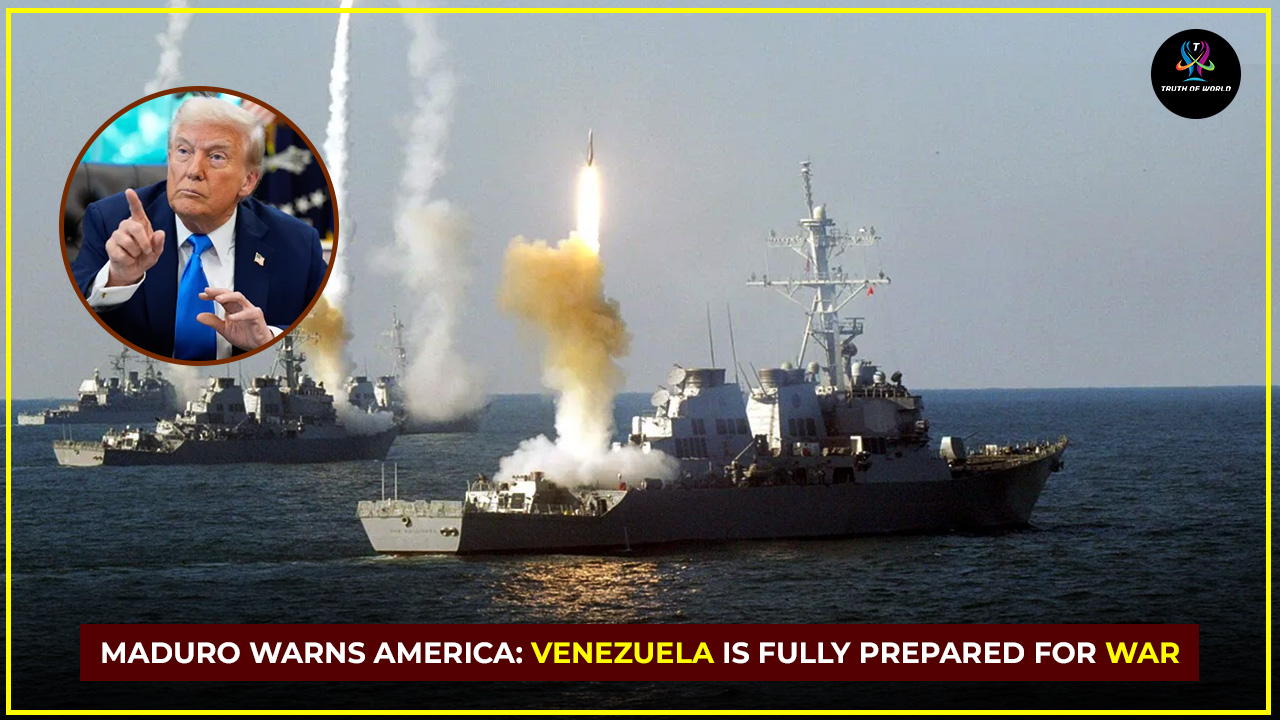
In early October 2025, several intelligence reports and maritime monitoring agencies confirmed an unusual increase in U.S. naval activity in the Caribbean, particularly off the Venezuelan coast.
At least six U.S. Navy ships were spotted conducting “maritime security operations,” according to the Pentagon.
Washington insists these operations are part of an anti-narcotics mission, targeting illegal drug routes in the region.
However, Venezuelan officials allege that these are covert preparations for an invasion or targeted strikes aimed at destabilizing Maduro’s government.
Venezuela’s defense ministry said it detected drones and surveillance aircraft “operating dangerously close” to its airspace earlier this month.
Maduro Accuses U.S. of “Imperial Ambition”
During his speech, Maduro directly accused Washington of trying to provoke a war to seize Venezuela’s massive oil and gold reserves.
“The empire has never forgiven Venezuela for reclaiming its sovereignty,” he said.
“They want to turn our homeland into another Iraq or Libya, but they will not succeed.”
Maduro also claimed that U.S. covert operations have intensified in neighboring Colombia and Guyana, suggesting that these countries are being used as potential launch points for “hybrid warfare” against Venezuela.
What Is Plan Independence 200?
“Plan Independence 200” was launched earlier this year to commemorate the bicentennial of Venezuela’s independence.
It is a massive military readiness program involving:
- Over 350,000 armed forces personnel,
- Nearly one million civilian militia volunteers,
- Coastal radar and missile systems,
- Anti-aircraft training programs,
- And cyber-defense units.
Officials say the plan aims to “ensure national sovereignty and resist external aggression,” combining conventional defense with local resistance strategies.
U.S. Response: “No Intention to Invade”
So far, the United States government has denied any plan to invade Venezuela.
A spokesperson from the White House National Security Council told reporters:
“Our actions are focused on combating transnational crime and protecting maritime trade routes.
We have no intention of engaging militarily with Venezuela unless our interests or personnel are directly threatened.”
Nevertheless, analysts warn that the language from both sides has grown dangerously confrontational.
President Trump’s recent confirmation that the CIA has been authorized to conduct “limited intelligence operations” in Venezuela has only added to suspicions in Caracas.
Growing Fear of Escalation
Regional observers are worried that miscommunication or a small military incident could trigger a wider regional conflict.
Security analyst Dr. Sofia Ramos of the University of São Paulo told Global News Today:
“The U.S. operations in the Caribbean, combined with Maduro’s mobilization order, have created a high-tension environment. Even a misunderstanding like an aircraft entering restricted airspace could lead to direct confrontation.”
Neighboring countries such as Colombia, Brazil, and Guyana have already increased border patrols and surveillance amid fears of spillover effects.
Humanitarian and Economic Implications
While military preparations intensify, ordinary Venezuelans face deepening economic hardship.
Food shortages, inflation, and international sanctions have severely impacted living conditions.
Analysts fear that the latest escalation could worsen the humanitarian crisis, prompting new waves of migration toward Colombia and other nearby nations.
“People are tired of fear,” said a Caracas resident, María Pérez, speaking to a local news outlet.
“We just want peace not another war that we can’t afford.”
International Reaction
The United Nations and several Latin American governments have called for restraint.
The UN Secretary-General urged both Washington and Caracas to “avoid inflammatory rhetoric” and return to diplomatic channels.
Mexico and Argentina have offered to mediate between the two sides.
Meanwhile, Russia, China, and Iran key allies of Venezuela expressed support for Maduro’s government, calling any U.S. military action “unacceptable interference.”
Moscow’s foreign ministry warned that “aggression against Venezuela would destabilize the entire region,” hinting at possible economic or logistical support to Caracas if tensions escalate.
Analysts Say Situation Could Mirror Cold War Proxy Tensions
Experts compare the situation to Cold War-style proxy confrontations, with major powers testing each other’s resolve in the Western Hemisphere.
If U.S. and Venezuelan forces were to clash even briefly the result could realign regional politics for decades.
“This is not just about oil or ideology,” said geopolitical analyst James Harper.
“It’s about influence who controls the narrative and power structure in Latin America.”
What’s Next?
As both sides continue to harden their positions, several possible scenarios are emerging:
- Diplomatic De-escalation:
International pressure could push both governments to negotiate through intermediaries such as the UN or OAS. - Limited Military Clash:
A naval or aerial incident could spark a short-term confrontation, though both sides may avoid a full-scale war. - Information and Cyber Warfare:
Instead of traditional combat, both nations could escalate digital warfare — hacking, propaganda, and cyberattacks. - Domestic Repercussions in Venezuela:
Maduro could use the crisis to consolidate power internally, while opposition forces may accuse him of manufacturing a “foreign threat” to distract from economic collapse.
Why This Matters Globally
The standoff is not just about Venezuela’s sovereignty — it’s about geopolitical influence, global energy markets, and democratic stability.
Venezuela holds some of the world’s largest oil reserves, and any disruption there could impact global energy prices.
Additionally, this crisis could determine how far the U.S. is willing to extend its military influence in Latin America in the 21st century
Final Thoughts
With his statement that Venezuela’s defense plan is “complete,” President Nicolás Maduro has drawn a clear red line signaling that Caracas is prepared for confrontation if provoked.
While Washington insists it seeks only to fight organized crime and narcotics, the growing militarization around Venezuela’s borders tells a different story.
For now, the world watches closely as two nations on opposite ideological poles move closer to a dangerous crossroads.
Whether this will end in dialogue or disaster depends on diplomacy, restraint, and the willingness of global powers to step back from the brink.