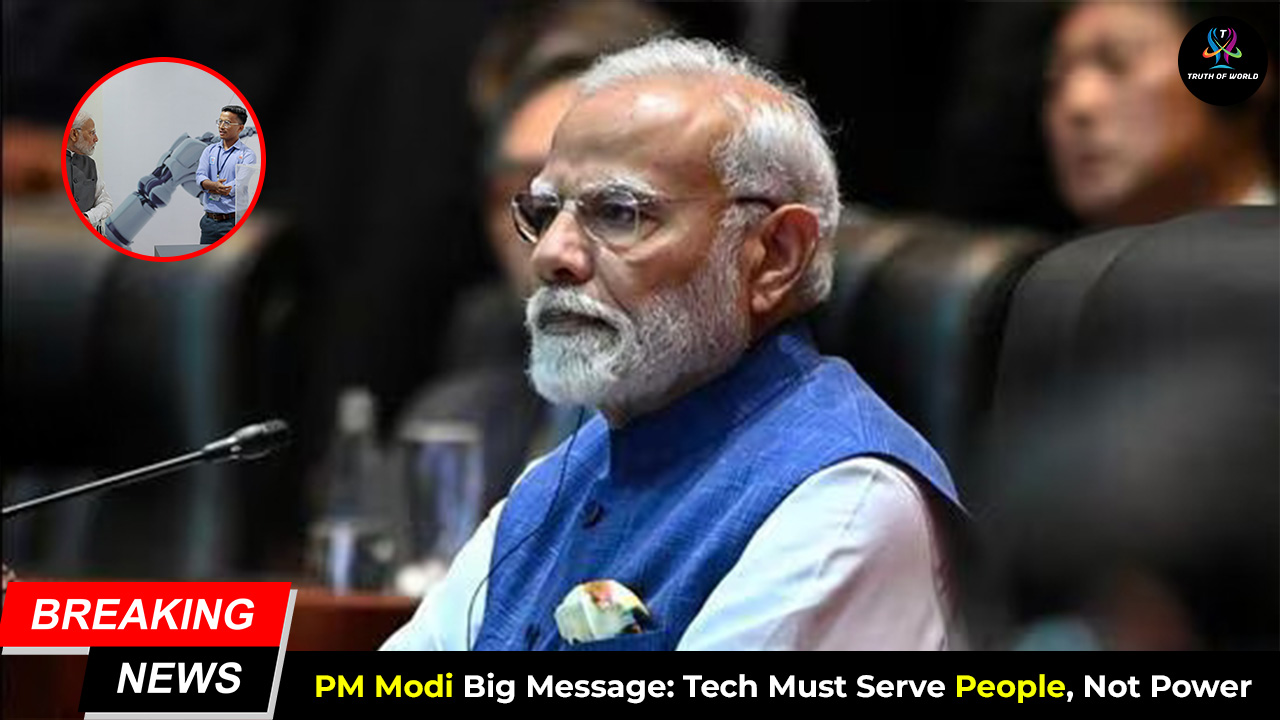
In a landmark address at the two-day National Conference on “Strengthening Legal Aid Delivery Mechanisms”, the Narendra Modi-led government reiterated its commitment to ensuring justice, inclusion and empowerment in modern India. Speaking at an event organised by the National Legal Services Authority (NALSA) on 8 November 2025 in New Delhi, the Prime Minister underscored that while technology inevitably acts as a disruptive force, when aligned with a pro-people focus, it becomes a powerful tool for democratization of justice.
This conference, marking the 30th anniversary of NALSA, gathered dignitaries across the judiciary, government and legal services fraternity including the B. R. Gavai (Chief Justice of India and Patron-in-Chief of NALSA), Surya Kant (Executive Chairman of NALSA), and Union Law Minister Arjun Ram Meghwal. The gathering served as a platform to highlight key developments in India’s justice delivery architecture, especially focusing on access to legal aid, community mediation, and technological reform.
The backdrop: access, aid and justice for all
When addressing the audience, Prime Minister Modi reiterated a foundational principle: “When justice is accessible to all, delivered in a timely manner, and reaches every individual regardless of their social or financial background that is when it truly becomes the foundation of social justice.” He emphasised role of legal aid as being central to that ideal, positioning NALSA and its affiliated institutions as the link between the judiciary and citizens at the grassroots.
The PM noted that NALSA, over its three-decade history, has tried to reach those lacking representation, resources or hope. He expressed satisfaction at the expansion of mechanisms such as Lok Adalats and pre-litigation settlement frameworks, noting that lakhs of disputes are now being resolved at lower cost and with faster turnaround.
He reminded the legal services community that the true meaning of ‘service’ is when the marginalized receive help, hope and representation not merely when statistics improve. This focus on human outcomes underlines the government’s “justice for all” narrative.
Community mediation and revival of a traditional ethos
One of the notable announcements at the conference was the launch of NALSA’s Community Mediation Training Module. The Prime Minister explained that mediation has always been part of India’s civilisational fabric from gram panchayats and village elders to traditional dispute-resolution. With the passage of the new Mediation Act, this tradition is being modernised.
Modi suggested that by training community mediators, disputes can be handled amicably, locally, cost-effectively, and quickly reducing burden on courts and fostering harmony. He viewed this as an important step in bringing dispute-resolution closer to people, rather than only through formal litigation channels.
Such local mediation also supports the broader aim of easing access to justice — especially for those in rural or marginalised communities, who often face high barriers in approaching formal legal mechanisms. The PM emphasised that technology, local knowledge and human empathy must all work together to deliver meaningful results. As one of the senior judges, Justice Surya Kant, put it: “Technology does offer real opportunities, but it alone will not suffice. It must be guided by local knowledge, linguistic accessibility and human empathy.”
Technology Disruptive, yes; but pro-people focus matters
Central to the Prime Minister’s address was the theme of technology’s dual nature. “Technology is certainly a disruptive force. But if it has a pro-people focus, then the same technology becomes a power of democratisation,” he declared.
Modi cited concrete examples: Digital Payments via UPI, optical‐fibre connectivity in villages, the simultaneous launch of nearly one lakh mobile towers in rural areas, and the ongoing roll-out of the eCourts project. These, he said, show how technology has moved from being purely technical to becoming a vehicle of inclusion and empowerment.
He underscored the eCourts initiative: from e-filing, digital summons, virtual hearings to video-conferencing, the digitalisation of judicial processes is making access to justice faster, simpler and more humane. Notably, the budget for the third phase of the eCourts project has been increased to over ₹7,000 crore, reflecting a strong government commitment.
However, he noted that technology alone isn’t sufficient it must be combined with empathy, human-centred design, accessibility in local languages, and awareness of social realities. The risk without this focus is one of exclusion rather than empowerment.
Legal awareness, local language, and inclusive justice
Another key focus in the Prime Minister’s speech was on legal awareness and linguistic accessibility. He reminded the gathering that a poor person cannot access justice unless they know their rights, understand the law, and overcome the fear and complexity of the system.
He urged law students, volunteers and legal services institutions to engage directly with rural communities, self-help groups, Panchayati Raj institutions and grassroots networks in effect, taking the law to the people rather than waiting for people to come to the law.
On language, Modi made a pointed remark: “The language of justice should be such that it is understood by the person seeking justice.” He praised the Supreme Court’s initiative to translate over 80,000 judgments into 18 Indian languages and called for similar efforts in High Courts and district-level courts.
He emphasised that when people understand laws and judgments in their own language, compliance improves and litigation reduces. This reflects both a practical efficiency argument and a deeper commitment to inclusive justice.
Structural reforms and achievements so far
In contextualising the government’s efforts, Prime Minister Modi referenced some structural reforms: over the past 11 years the government has focused on “Ease of Doing Business and Ease of Living” but he stressed that such efforts are incomplete unless “Ease of Justice” is also ensured.
He pointed to removal of more than 40,000 unnecessary compliances for businesses, de-criminalisation of over 3,400 legal provisions through the Jan Vishwas Act, and repeal of over 1,500 obsolete laws culminating in the replacement of older statutes by the Bharatiya Nyaya Sanhita.
Importantly, in the domain of legal aid, under the Legal Aid Defence Counsel system, nearly 8 lakh (800,000) criminal cases have been disposed of in just three years underscoring the operational scale of the effort.
The event also highlighted NALSA’s growing role. Over three decades, the institution has tried to bridge the gap between the judiciary and under-privileged citizens. The Prime Minister encouraged all members of NALSA to continue their work with patience and professionalism.
Why this focus matters and what lies ahead
Why is the focus on technology + people so significant? In a country as large and diverse as India, with vast rural populations, multiple languages, and deeply entrenched inequalities, access to justice remains a major barrier. Formal courts are often distant, expensive, and slow. Legal aid infrastructure, though improved, still struggles with resource constraints and awareness gaps.
Integrating technology digital portals, online filings, virtual hearings brings the promise of access, efficiency and scalability. But without a pro-people focus, such initiatives may merely digitise exclusion. Hence, the Prime Minister’s insistence that technology must be guided by empathy, inclusion, linguistic accessibility and local knowledge.
The launch of the Community Mediation Training Module is a key example of marrying technology with tradition and people-centric processes. It represents a decentralisation of dispute resolution, bringing it closer to the community, and combining digital tools with grassroots human engagement.
Moving ahead, key priorities will include:
- Legal awareness and outreach: Ensuring vulnerable populations — women, elderly, rural poor, marginalized communities know their rights, understand the law and have trust in the system. As Modi emphasised, awareness is the pre-condition for access.
- Language & accessibility: Expanding translation of judgments, documents and legal aid interfaces into regional languages, so that pivotal legal knowledge is not lost in translation.
- Technological infrastructure: Scaling up projects like eCourts, digital mediation platforms, and rural connectivity, so technology becomes a true equaliser rather than a new barrier.
- Institutional capacity & reform: Strengthening panel lawyers, paralegal volunteers, legal services authorities, local mediation centres and integrating these into an efficient network of justice delivery.
- Community-centred models: Building on the tradition of mediation, local dispute resolution and community engagement rather than solely relying on formal courts. The new module is a step in this direction.
Concluding reflections
The address by Prime Minister Narendra Modi at the NALSA conference underscores a turning point in India’s justice delivery discourse one that seeks to harness the disruptive power of technology, while rooting it firmly in human-centric, people-focused systems. The message is clear: technology by itself may shake up systems, but it gains meaning and legitimacy only when it empowers real people, especially those who have been historically excluded.
As India continues its journey towards becoming a developed nation, ensuring “Ease of Justice” alongside “Ease of Doing Business” and “Ease of Living” is vital. The focus on the pro-people axis — legal awareness, language, local processes, and community involvement signals an evolution in how justice is envisioned. The litmus-test of these reforms will not only be how many judgments are delivered faster or how many cases are resolved digitally, but whether a farmer in a remote village, a woman in a marginalised community or an elderly person in a small town truly feels that the law belongs to them, that the system speaks their language, and that their voice matters.
In the Prime Minister’s words: when justice reaches every individual “without looking at their social or financial background, it becomes the foundation of social justice.” The challenge ahead is to translate that promise into lived reality across India’s diverse landscape.