New Delhi: The Indian government has officially termed the recent explosion near Delhi’s historic Red Fort as a “terror incident”, citing possible links to a recently busted terror module in Jammu and Kashmir, according to senior intelligence sources.
The blast, which ripped through a parked car on Monday evening, has left at least 12 people dead and more than 20 injured, sparking widespread panic in the capital and raising serious security concerns ahead of the winter session of Parliament.
The Blast and Immediate Response
The explosion occurred around 6:45 p.m. in the bustling Old Delhi area, when a white Hyundai i20 suddenly burst into flames near the Red Fort’s main parking zone. Police initially suspected a gas cylinder leak, but forensic teams soon confirmed the use of improvised explosive devices (IEDs) packed with shrapnel.
Union Home Minister Amit Shah called an emergency meeting with intelligence agencies and Delhi Police officials, directing a full-scale investigation.
“The incident bears the hallmarks of a planned terror attack,” a senior official from the National Investigation Agency (NIA) told reporters. “We are not ruling out connections with terror networks operating in Kashmir.”
Possible Kashmir Connection
The NIA and Jammu & Kashmir Police are jointly probing whether the blast is linked to a series of recent arrests in Pulwama and Srinagar, where several individuals including four doctors and two medical students were detained for allegedly aiding a Pakistan-based terror group, Jaish-e-Mohammed (JeM).
Investigators believe that one of the key suspects from that group may have coordinated the procurement of explosives used in the Delhi blast. Over 2,900 kilograms of bomb-making materials were reportedly seized during raids in Kashmir earlier this month.
A senior security source said:
“This may be part of a larger, sophisticated network what we call a ‘white-collar terror ecosystem’ involving educated individuals providing logistical or medical support to extremist outfits.”
Government and Political Reaction
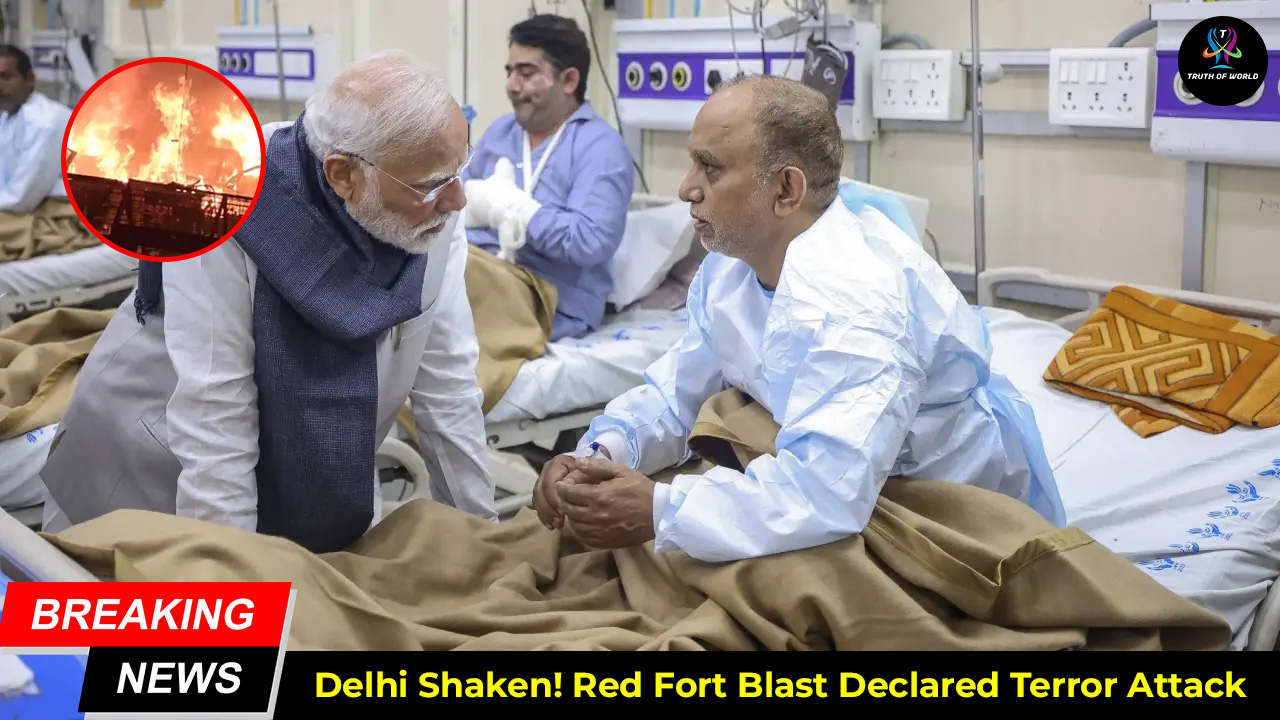
Prime Minister Narendra Modi condemned the attack, describing it as a “cowardly and despicable act by anti-national forces”, and assured that “every individual behind this conspiracy will be brought to justice.”
Following the blast, the Delhi Police imposed high alert across sensitive zones, including airports, metro stations, and government offices. Security has also been tightened around major religious sites in the city.
Home Ministry sources confirmed that over 500 people have been detained for questioning across Delhi, Haryana, and Jammu & Kashmir. Several digital devices and documents have been seized for forensic examination.
Security Implications and Rising Concerns
This is the first major terror-related explosion in Delhi in nearly a decade, reviving fears of sleeper cells operating in northern India. Security experts warn that groups are increasingly relying on educated recruits and digital communication tools to evade detection.
Intelligence agencies are now focusing on whether foreign funding or encrypted communication platforms were used to coordinate the attack. Preliminary data suggests possible online links traced to servers in the Middle East.
International Reactions
Several world leaders, including U.S. Secretary of State Antony Blinken and U.K. Prime Minister Keir Starmer, extended condolences to the victims and expressed solidarity with India’s anti-terror efforts.
Meanwhile, Pakistan’s foreign office issued a brief statement denying involvement and urging “transparency and restraint” in the investigation a remark that drew strong criticism from Indian officials.
The Road Ahead
As the NIA widens its probe, investigators are examining surveillance footage, mobile call records, and car registration data to identify how the explosives were planted.
Officials have hinted at possible arrests “within the next 48 hours.”
Security analyst Ajay Sahni noted:
“This incident shows a worrying trend terror operations are no longer confined to border states. Networks are embedding themselves within professional sectors, using technology and education as new weapons.”
The Delhi Red Fort blast has once again highlighted the persistent challenge India faces in countering hybrid forms of terrorism — where radical ideology meets modern intelligence and digital coordination.
As the investigation unfolds, authorities are determined to trace every link from Kashmir’s silent handlers to Delhi’s unsuspecting streets in what could be one of the most complex terror probes in recent years.