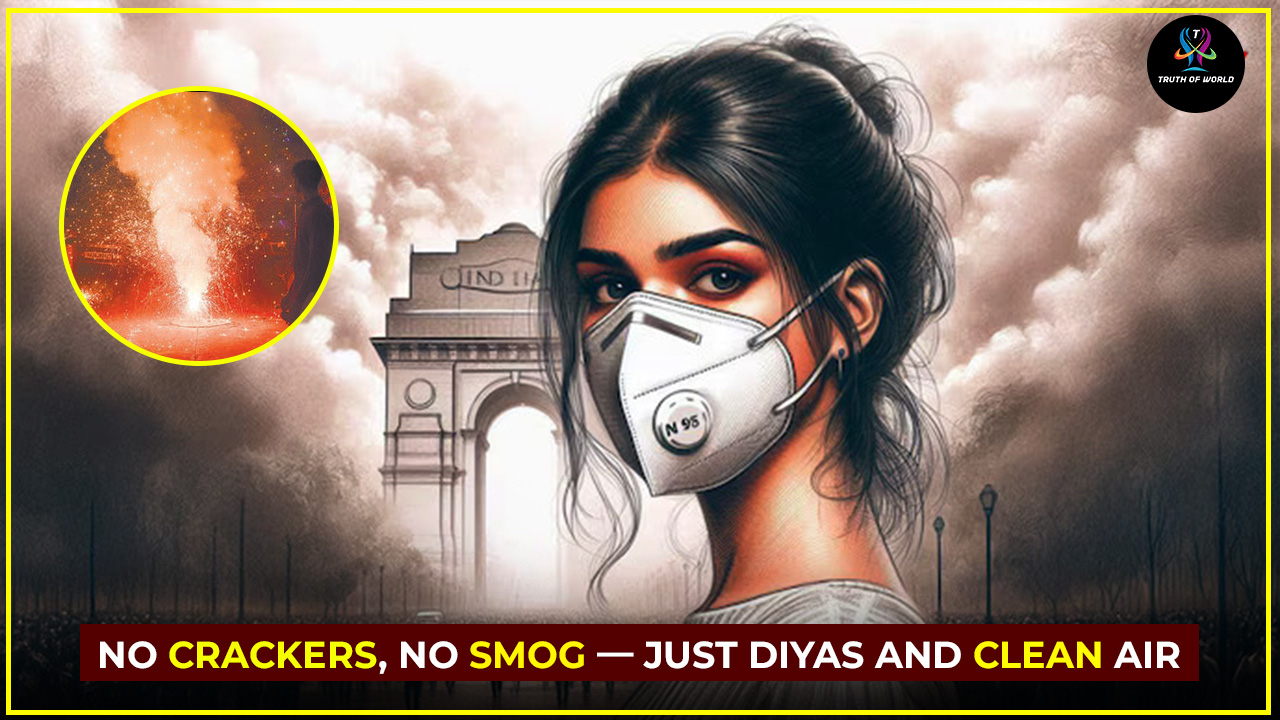
New Delhi— The capital is preparing for a historic celebration this year its first ever fully eco-friendly Diwali. With air quality levels sliding into the ‘severe’ zone and a toxic haze cloaking the skyline, Delhi is determined to prove that the spirit of Diwali can shine without smoke and noise.
While citizens brace for the joy and brightness of the festival, environmental experts are warning that this year’s celebrations will be a true test of awareness, responsibility, and collective discipline.
Delhi’s Air Quality Turns Toxic Before Diwali
In the run-up to Diwali 2025, the Air Quality Index (AQI) in Delhi has reached alarming levels, crossing 430 in several monitoring stations, including Anand Vihar, Wazirpur, and Narela. The smog, mixed with emissions from vehicles, industrial activities, and crop burning in neighboring states, has turned the city’s skyline a ghostly gray.
The India Meteorological Department (IMD) predicts that stagnant air, low temperatures, and calm winds will worsen the pollution in the next few days. “Weather is not going to help us this week,” said Dr. Vinod Joshi, senior scientist at the CPCB. “If residents ignore the ban and burst regular crackers, we might see AQI levels hitting 500 by the next morning.”
Government Reinforces Total Ban on Regular Firecrackers
To prevent a repeat of past years, the Delhi government has reiterated its complete ban on the sale, storage, and bursting of traditional firecrackers. Only certified green crackers will be permitted, provided they comply with the emission standards defined by the Council of Scientific and Industrial Research (CSIR-NEERI).
In his public address, Delhi Environment Minister Gopal Rai said, “This Diwali, we appeal to everyone celebrate with lights, not pollution. The health of our children and elders must come first.”
Over 200 enforcement teams have been deployed across the city to monitor markets and residential areas. Violations will invite strict penalties, including fines up to ₹10,000 and possible jail terms under the Air (Prevention and Control of Pollution) Act.
Understanding Green Crackers: How They Differ from Traditional Ones
Green crackers, developed by CSIR–NEERI, are made to emit 25–30% less pollutants than conventional fireworks. They eliminate harmful metals such as barium and lithium and are designed to reduce PM2.5 and PM10 emissions, which are the major contributors to Delhi’s winter smog.
Each green cracker pack carries a QR code that buyers can scan to verify authenticity. Types include:
- SWAS (Safe Water Releaser) – emits water vapor and less dust.
- SAFAL (Safe Minimal Aluminum) – produces minimal sound and smoke.
- STAR (Safe Thermite Cracker) – significantly cuts emissions and metal particles.
These eco-friendly alternatives produce more light than smoke, ensuring that the festival spirit remains intact while keeping the air cleaner.
Mixed Public Reaction Across the Capital
The city appears divided on the green Diwali initiative. While many support the move, others feel it undermines tradition.
Rohit Mehra, a college student from Lajpat Nagar, said, “Diwali without crackers feels incomplete, but I’m okay using green ones if it helps the environment.”
On the other hand, Ananya Verma, a mother of two from Dwarka, believes it’s a step long overdue. “Every Diwali, my daughter ends up with wheezing and cough. If banning fireworks helps even a little, I’m all for it,” she said.
Experts emphasize that changing public behavior will take time. “The challenge is cultural, not technical,” noted Dr. Shweta Sharma, an environmental sociologist. “The government must pair restrictions with public awareness and accessible alternatives.”
Schools, RWAs, and NGOs Lead ‘Green Celebration’ Campaigns
To strengthen the awareness drive, schools across Delhi have launched “My Air, My Responsibility” programs. Students are pledging not to burst crackers and to encourage their families to do the same.
Several Resident Welfare Associations (RWAs) have also joined the movement, organizing community Diwalis featuring traditional diya lighting, cultural performances, and tree-planting drives.
Rajiv Malhotra, president of an RWA in Greater Kailash, said, “We’re celebrating with dance, music, and sweets no crackers this time. It’s a cleaner, more joyful way to mark the festival.”
Meanwhile, NGOs such as Clean Delhi Now and Youth for Air are conducting awareness rallies and distributing green cracker information leaflets across marketplaces.
Emergency Pollution Control Measures in Force
Under the Graded Response Action Plan (GRAP) Stage IV, Delhi has implemented emergency steps to control pollution. Construction and demolition activities have been suspended, heavy vehicles have restricted entry, and water sprinkling operations are in full swing.
Over 500 anti-smog guns have been deployed, especially in pollution hotspots such as ITO, Rohini, and Dwarka. The Delhi Fire Department has also been instructed to stay alert for potential accidents caused by illegal cracker usage.
“Smog towers are functional, and we’ve increased real-time air quality monitoring,” said a senior Delhi Pollution Control Committee (DPCC) officer. “But unless people cooperate, these efforts will have limited impact.”
Stubble Burning Adds to Delhi’s Woes
Despite multiple appeals from the Centre, stubble burning in Punjab and Haryana has continued. Satellite images from NASA’s FIRMS data revealed over 2,500 active farm fire incidents this week.
Experts estimate that nearly 30% of Delhi’s current pollution load is due to smoke from crop residue burning. “The issue is systemic,” said environmental expert Dr. A.K. Singh. “Farmers need long-term incentives for crop residue management instead of short-term bans.”
The government is pushing for greater adoption of technologies like Happy Seeder machines and biodecomposer sprays, which convert crop waste into organic fertilizer.
Delhi Markets See Rise in Eco-Friendly Festive Goods
Despite pollution worries, festive enthusiasm remains strong. Delhi’s popular markets from Chandni Chowk to Sarojini Nagar are bustling with shoppers buying clay diyas, organic rangoli powders, and LED decorations.
Traders say demand for green crackers and biodegradable decorations has doubled this year. “People are more aware now. Green products are trending,” said Ravi Gupta, a shopkeeper in Karol Bagh.
Online marketplaces are also promoting “Zero Pollution Diwali” campaigns, offering discounts on eco-friendly lighting and gifting options.
Health Concerns Rise as Hospitals Prepare
Hospitals across Delhi are preparing for a post-Diwali surge in respiratory cases. The AIIMS Department of Pulmonology has issued guidelines for vulnerable groups, including the elderly, children, and asthma patients.
Dr. Neha Bansal, a pulmonologist, warned, “Pollution doesn’t just irritate the throat it penetrates deep into the lungs, causing long-term damage. We see spikes in bronchitis, COPD, and eye irritation after every Diwali.”
She advised residents to stay indoors during peak smog hours, use air purifiers if possible, and wear N95 masks while stepping out.
While the immediate concern is Diwali pollution, experts emphasize that long-term strategies are essential. “We can’t fix Delhi’s air crisis with seasonal bans,” said Dr. Gufran Beig, founder of SAFAR-India. “The solution lies in continuous emission monitoring, electric mobility, and renewable energy adoption.”
He further stressed that both state and central governments need to collaborate beyond the festival season. “Pollution control should be a 12-month effort, not a two-week campaign.”
A Festival of Light, Not Smoke
This year’s Diwali offers Delhi an opportunity to redefine celebration in a way that honors both culture and climate. The message is clear: lighting diyas doesn’t mean darkening the skies.
In a heartfelt message, Chief Minister Arvind Kejriwal said, “Let’s celebrate this Diwali by lighting diyas of hope, not clouds of smoke. Our children deserve cleaner air and a brighter future.”
Citizens are being urged to replace firecrackers with kindness by donating to the needy, planting trees, and supporting eco-friendly businesses.
As the city glows with millions of diyas, Delhi hopes this Diwali will be remembered not for smog-filled mornings, but for clear skies and a shared sense of responsibility.